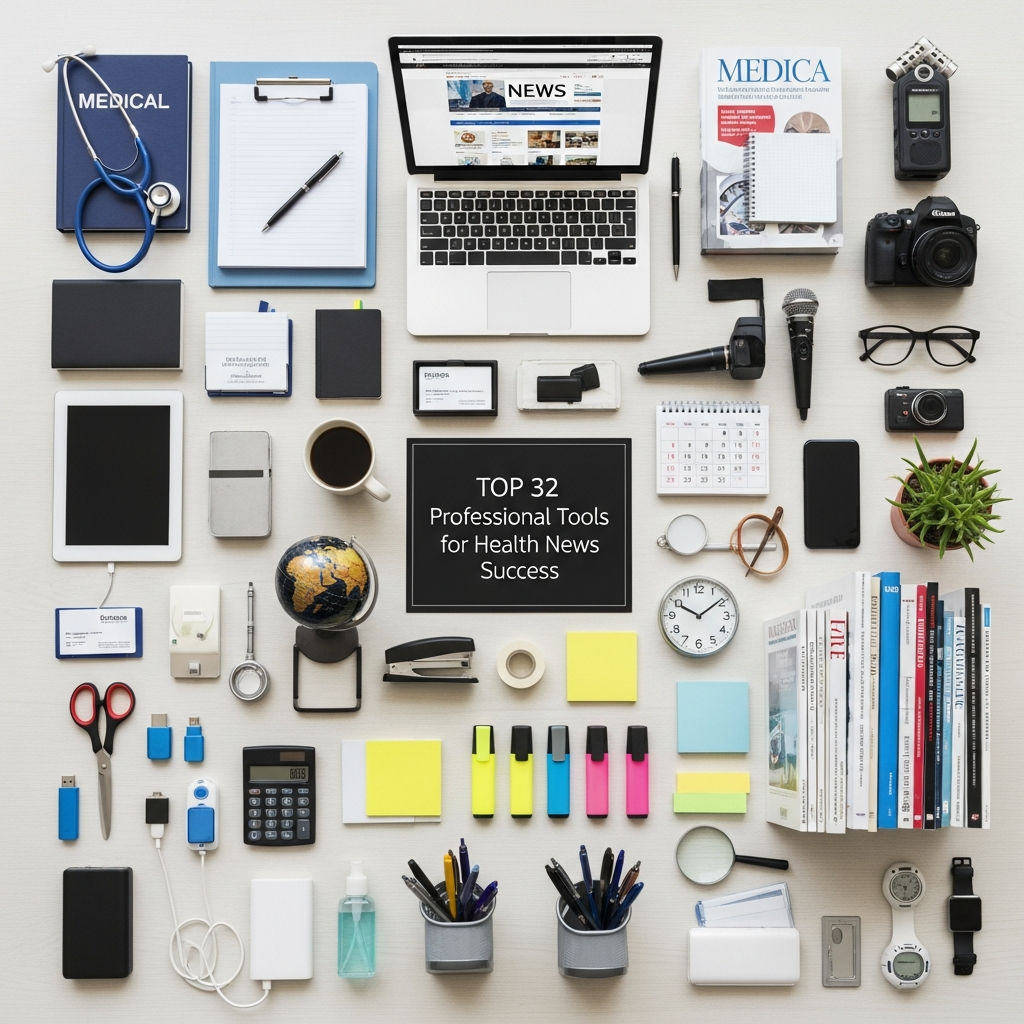
Top 32 Professional Tools for Health News Success
In the fast-paced world of health journalism and medical content creation, accuracy, speed, and authority are the pillars of success. Reporting on health is not just about catching the latest trend; it is about distilling complex scientific data into actionable information that can literally save lives. To excel in this niche, professionals must leverage a sophisticated tech stack that spans research, SEO, data visualization, and distribution.
Whether you are a seasoned medical journalist, a healthcare PR specialist, or a wellness blogger, these 32 professional tools are essential for achieving health news success in a competitive digital landscape.
Research and Fact-Checking Tools
The foundation of any health story is credible data. In an era of misinformation, these tools help ensure your reporting is backed by peer-reviewed evidence.
1. PubMed
Managed by the National Center for Biotechnology Information (NCBI), PubMed is the gold standard for accessing over 35 million citations for biomedical literature. It is the first stop for any health reporter looking to verify a scientific claim.
2. The Cochrane Library
For high-quality, independent evidence to inform healthcare decision-making, Cochrane is unmatched. Their systematic reviews are essential for understanding the actual efficacy of medical treatments.
3. Google Scholar
While a broader tool, Google Scholar allows you to search across disciplines and sources: articles, theses, books, and abstracts from academic publishers and professional societies.
4. ScienceDirect
A leading resource for peer-reviewed scholarly literature, ScienceDirect is vital for finding full-text articles in the fields of physical, life, and health sciences.
5. Retraction Watch
Integrity is key in health news. Retraction Watch tracks retracted papers, helping journalists avoid reporting on “zombie science” or discredited studies.
SEO and Trend Discovery Tools
Writing a great story is only half the battle; people need to find it. These tools help you align your content with what the public is searching for.
6. SEMrush
An all-in-one marketing toolkit, SEMrush is excellent for keyword research, competitor analysis, and identifying “health clusters” where your publication can dominate search results.
7. Ahrefs
Known for its superior backlink analysis, Ahrefs helps health news sites understand their authority and find content gaps that competitors are missing.
8. Google Trends
Essential for real-time reporting, Google Trends allows you to see what health concerns are spiking in specific geographic locations, such as flu outbreaks or interest in new dietary fads.
9. AnswerThePublic
This tool visualizes search questions and suggested autocomplete searches. It is perfect for health news because it reveals the specific “how-to” and “why” questions patients are asking.
10. BuzzSumo
BuzzSumo helps you identify which health stories are going viral on social media, allowing you to pivot your coverage to high-engagement topics.
Data Visualization and Medical Illustration
Health news often involves dense statistics or biological processes. These tools help make the invisible visible and the complex understandable.
11. BioRender
Standard icons aren’t enough for medical news. BioRender allows you to create professional, scientifically accurate biological diagrams and illustrations in minutes.
12. Canva
For quick infographics, social media headers, and featured images, Canva remains the most accessible tool for newsrooms without a dedicated design department.
13. Flourish
Owned by Canva, Flourish is specialized for data visualization. It is excellent for creating interactive maps of disease spreads or charts showing clinical trial results.
14. Piktochart
Piktochart is ideal for turning complex health reports into digestible visual stories and posters for digital distribution.
15. Adobe Express
A powerhouse for creating high-quality visual content quickly, Adobe Express offers templates tailored for professional communication and news layouts.
Sourcing Experts and Networking
Every health story needs a quote from a specialist. These tools bridge the gap between journalists and the medical community.
16. Connectively (Formerly HARO)
Connectively is a vital tool for finding doctors, researchers, and patients willing to be interviewed for your stories on a tight deadline.
17. Muck Rack
Muck Rack helps health journalists manage their portfolios and helps PR professionals find the right reporters to cover their medical breakthroughs.
18. ProfNet
Similar to HARO, ProfNet connects journalists with expert sources, often leaning more toward academic and institutional experts.
19. Qwoted
A modern alternative for sourcing, Qwoted helps eliminate spam by vetting experts and providing a more streamlined communication channel for reporters.
Content Organization and Collaboration
Managing an editorial calendar for a health news site requires meticulous organization to ensure no deadline is missed.
20. Trello
Using a Kanban board system, Trello is perfect for tracking a story from the “pitch” stage to “fact-checked” and finally “published.”
21. Notion
Notion acts as an all-in-one workspace. It is particularly useful for health news teams to build internal wikis of medical terminology and preferred sources.
22. Slack
Communication is vital for breaking news. Slack allows health newsrooms to coordinate in real-time, sharing leads and updates instantly.
23. Evernote
For the field reporter, Evernote is essential for capturing voice notes, snapping photos of conference slides, and organizing research on the go.
Editing and Accuracy Verification
In health news, a typo can lead to dangerous medical advice. These tools help maintain the highest editorial standards.
24. Grammarly
Beyond simple spell-check, Grammarly helps ensure the tone of your health reporting is professional, empathetic, and clear.
25. Hemingway Editor
Medical jargon can be dense. Hemingway helps you simplify your sentences to ensure your news is accessible to a lay audience without losing its meaning.
26. Medical Spell Checker
Standard dictionary tools often flag complex drug names and anatomical terms. Specialized medical spell checkers are essential for technical accuracy.
Transcription and AI Efficiency
Interviewing experts often results in hours of audio. These tools speed up the transcription process so you can get to the writing faster.
27. Otter.ai
Otter.ai offers high-quality real-time transcription, which is perfect for recording medical conferences or interviews with researchers.
28. Rev
When you need 100% accuracy for a high-stakes interview, Rev’s human transcription services are the industry standard.
29. Perplexity AI
As an “answer engine,” Perplexity is useful for finding quick citations and summaries of complex medical topics, though it should always be cross-referenced with primary sources.
Distribution and Audience Engagement
Once the story is written, you need to deliver it to your readers’ inboxes and social feeds.
30. Mailchimp
Email newsletters are the backbone of audience retention in the health niche. Mailchimp allows for easy automation of daily or weekly health briefings.
31. Buffer
To maintain a consistent social media presence across Twitter, LinkedIn, and Instagram, Buffer is a reliable scheduling tool.
32. Substack
Many independent health journalists are turning to Substack to build a direct, paid relationship with their readers, providing deep-dive analysis on niche medical topics.
Conclusion
Success in health news requires a delicate balance of journalistic integrity and modern digital savvy. By integrating these 32 tools into your workflow, you can ensure that your reporting is not only accurate and authoritative but also visible and engaging. In an industry where information is a critical component of public wellness, having the right toolkit is not just a professional advantage—it is a responsibility.